Skip to content

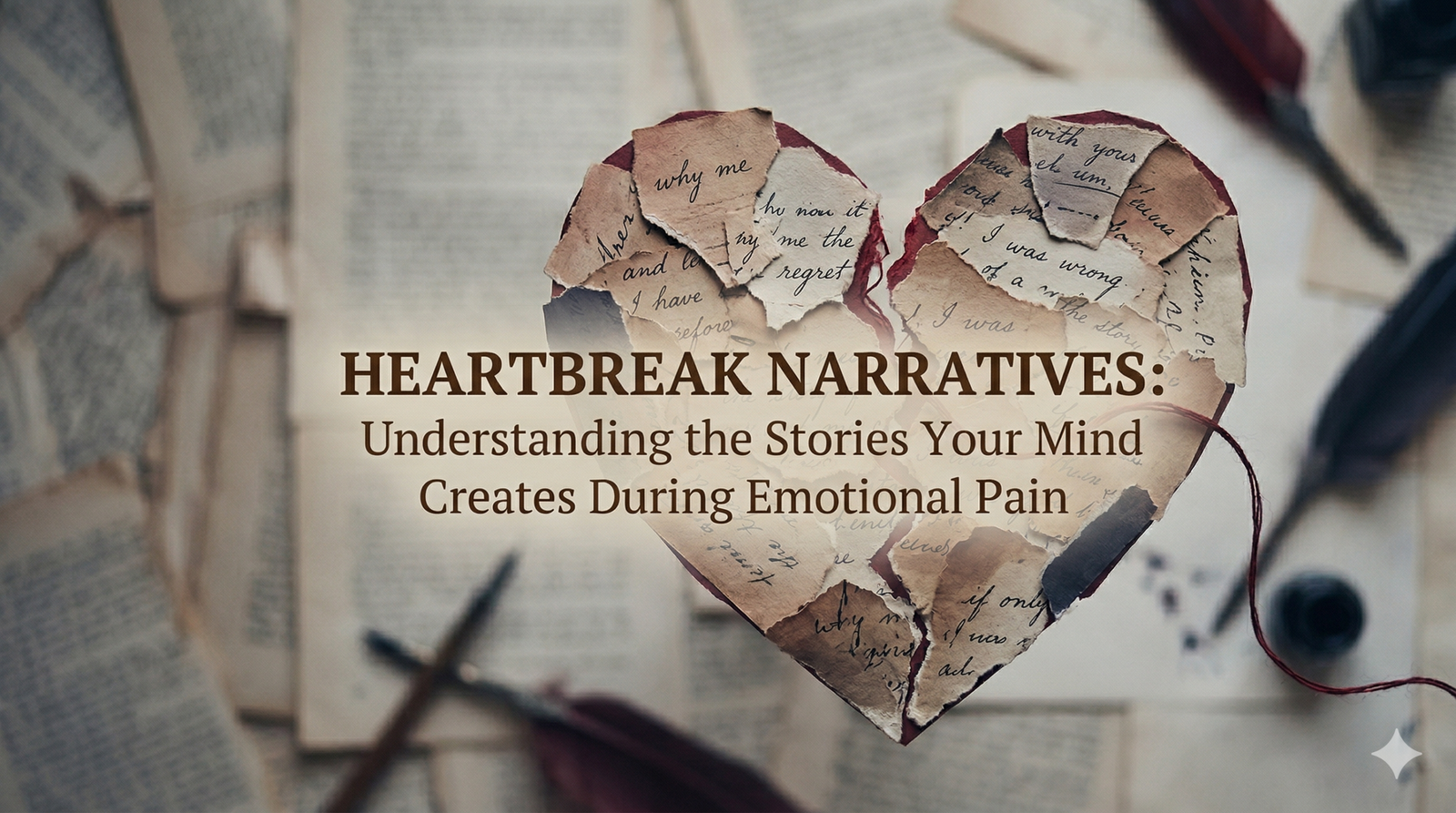
Heartbreak is not only an emotional experience. It is also a narrative experience.
When a relationship ends, the mind immediately starts building stories to make sense of what happened. These stories are not random. They are attempts to reduce uncertainty, regain control, and protect identity. However, many of these narratives can deepen suffering instead of resolving it.
Understanding the different narratives present during heartbreak can help people step out of unconscious loops and move toward healing with more clarity.
Why the Mind Creates Narratives During Heartbreak
From a psychological perspective, the brain is wired to seek meaning. When something emotionally significant ends, especially a relationship tied to attachment, the mind cannot tolerate ambiguity.
Research in attachment theory and cognitive psychology shows that after relational loss, the brain activates:
- Rumination loops (repetitive thinking to find answers)
- Threat detection systems (interpreting rejection as danger)
- Identity reconstruction processes (redefining the self without the relationship)
In simple terms, the mind creates stories because not knowing feels more painful than creating a potentially inaccurate explanation.
The Most Common Heartbreak Narratives
Below are the most frequent narratives people experience during heartbreak, explained in simple terms.
1. The “I Am Not Enough” Narrative
Thought pattern:
“I wasn’t enough. If I had been better, this wouldn’t have happened.”
What is happening:
The mind turns a complex situation into a personal flaw because self-blame feels more controllable than uncertainty.
Impact:
This narrative damages self-esteem and creates long-term insecurity in future relationships.
2. The “I Lost My Only Chance” Narrative
Thought pattern:
“They were the one. I will never find something like this again.”
What is happening:
The brain is reacting to loss by creating scarcity, making the past feel unique and irreplaceable.
Impact:
This reinforces emotional dependency and blocks openness to future connections.
3. The “It Was All an Illusion” Narrative
Thought pattern:
“Nothing was real. It was all fake.”
What is happening:
To reduce pain, the mind rewrites the relationship as meaningless, even if it wasn’t.
Impact:
This protects short-term emotions but can lead to distrust and emotional detachment.
4. The “I Need Closure” Narrative
Thought pattern:
“If I could just understand why, I would feel better.”
What is happening:
The brain seeks a clear, logical ending to calm emotional chaos.
Impact:
People may stay emotionally stuck, waiting for answers that may never come.
5. The “They Were Perfect” Narrative
Thought pattern:
“They were everything I wanted.”
What is happening:
Memory becomes selective, highlighting positive moments and minimizing problems.
Impact:
This idealization intensifies longing and delays emotional detachment.
6. The “I Was Replaced” Narrative
Thought pattern:
“They moved on so fast. I meant nothing.”
What is happening:
The brain interprets the other person’s actions as a direct reflection of personal value.
Impact:
This increases feelings of rejection and worthlessness.
7. The “Love Equals Pain” Narrative
Thought pattern:
“Every time I love, I get hurt.”
What is happening:
The mind generalizes one experience into a rule for all future relationships.
Impact:
This creates emotional avoidance and fear of intimacy.
8. The “I Need Them to Be Okay” Narrative
Thought pattern:
“I just want to know they’re okay. I still care.”
What is happening:
The attachment system is still active, seeking connection even after separation.
Impact:
This can prolong emotional attachment and delay healing.
9. The “I Should Be Over This” Narrative
Thought pattern:
“It’s been too long. I shouldn’t feel this way.”
What is happening:
The mind imposes unrealistic timelines on emotional processing.
Impact:
This adds shame on top of grief, making healing slower.
10. The “Something Is Wrong With Me” Narrative
Thought pattern:
“Why do I feel this much? Why can’t I move on?”
What is happening:
The intensity of grief is misinterpreted as a personal defect.
Impact:
This creates internal conflict and reduces self-compassion.
The Hidden Structure Behind These Narratives
Although these narratives seem different, most of them are built on three core emotional drivers:
1. Loss of Attachment
The nervous system loses a primary source of emotional safety and connection.
2. Loss of Identity
The person is no longer who they were within the relationship.
3. Loss of Future
The imagined life that was built mentally no longer exists.
Understanding this structure simplifies the experience. It is not just about losing a person. It is about losing a system of meaning.
How to Work With Heartbreak Narratives
The goal is not to eliminate these thoughts, but to relate to them differently.
1. Name the Narrative
Instead of believing the thought, identify it:
- “This is the ‘I am not enough’ narrative.”
- “This is the ‘I lost my only chance’ narrative.”
This creates distance between you and the thought.
2. Separate Feelings From Facts
A feeling of rejection does not mean you are objectively unworthy.
This distinction is critical for emotional stability.
3. Allow Emotional Processing
Research in emotional regulation shows that suppression increases distress.
Allowing emotions to move through the body reduces intensity over time.
4. Rebuild Identity Gradually
After heartbreak, identity needs reconstruction:
- New routines
- New environments
- New sources of meaning
This is not about replacing the past, but expanding beyond it.
5. Accept Incomplete Closure
Many relationships end without clear explanations.
Healing often comes from acceptance, not answers.
A Simple Way to Understand Heartbreak
Heartbreak is not just about losing someone.
It is the mind trying to reorganize itself after losing:
- A source of emotional safety
- A version of identity
- A vision of the future
The narratives that appear are not signs of weakness.
They are attempts by the brain to restore balance.
Final Perspective
Every narrative during heartbreak serves a function. Some protect. Some distort. Some prolong pain.
The key is not to fight these stories, but to see them clearly.
Once a person understands that these are narratives—not absolute truths—they begin to regain agency.
And from that point, healing is no longer about forgetting someone.
It becomes about integrating the experience without losing oneself.